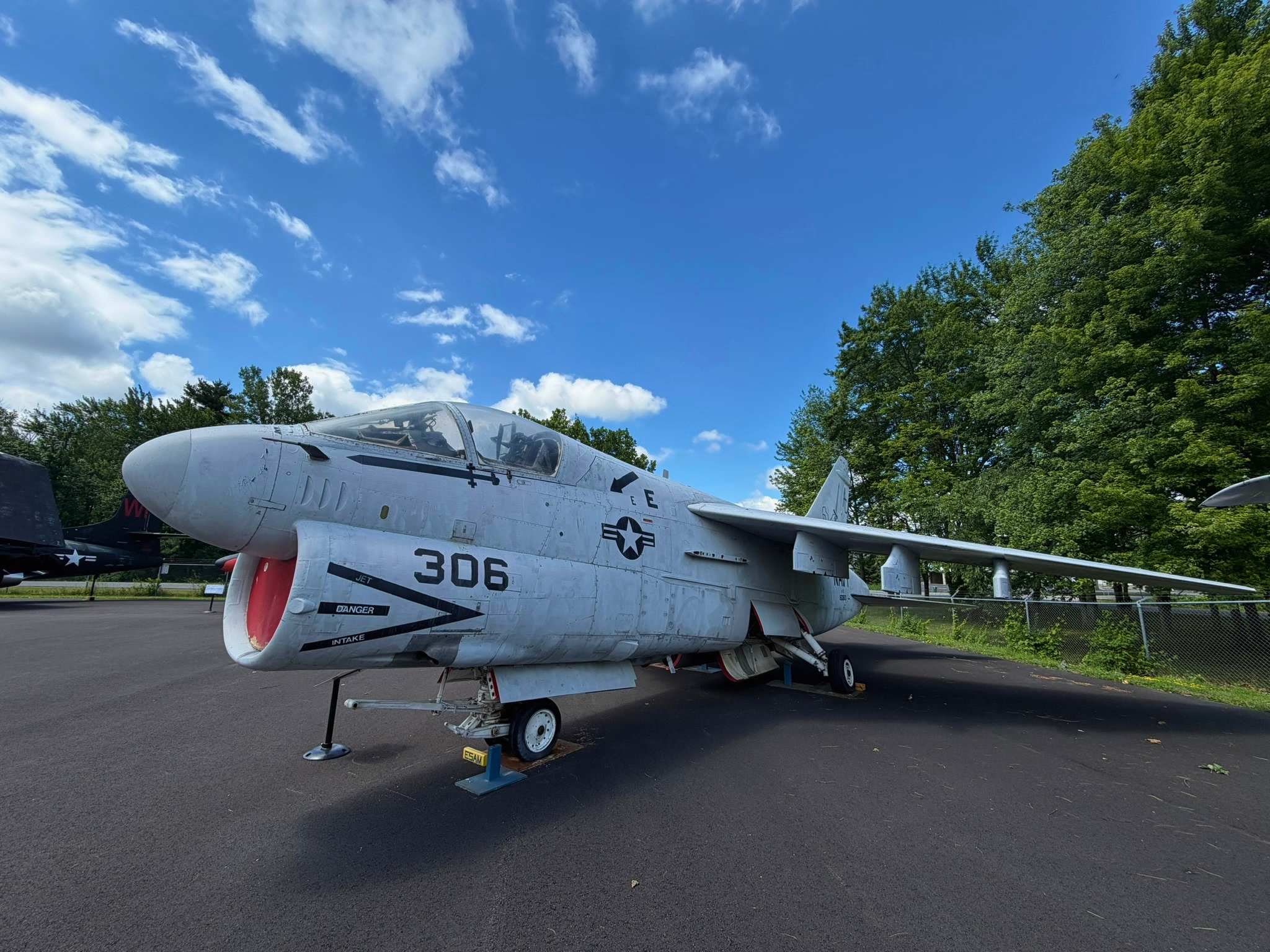
The A-7 was a sub-sonic light attack bomber developed initially for the U.S. Navy, but also adopted by the U.S. Air Force. During the mid-1960s, the
U.S. Navy was desperate for an attack aircraft to supplement the A-4 Skyhawk. Vought subsequently proposed a design based on its supersonic F-8 Crusader fighter, which was subsequently adopted by the Navy in 1963. The A-7 enjoyed one of the fastest and most trouble-free developments in modern aviation history, having entered operational service with the U.S. Navy in late 1966, only three years after initiation of its design, and with the U.S. Air Force shortly thereafter.
The A-7 was quickly deployed for service in the Vietnam War and proved to be an extremely reliable, rugged, and effective combat aircraft. Flying from both aircraft carriers and ground bases, the A-7 could carry up to 15,000 lbs of bombs on its six under-wing pylons, as well as two AIM-9 Sidewinder air-to-air missiles on launch rails along the fuselage, and an internally mounted 20mm Vulcan cannon. The A-7 was designed to outperform the nimble A-4 Skyhawk by a factor of two – carrying either twice the bomb load, or the same bomb load twice as far. Its integrated weapons computer provided high accuracy in its weapon delivery. The A-7 also pioneered several firsts - an inertial navigation system, heads-up-display, and turbo-fan engine.
The A-7 had a maximum speed of nearly 700 mph, and on a typical mission carrying 6,000 lbs of ordinance, had a radius of 715 miles.
A total of 1,600 Corsairs were manufactured, with a small number also operated by the air forces of Greece, Portugal, and Thailand. The A-7 was retired in 1993 following the Gulf War, having been replaced by the F/A-18 in Navy service and by the F-16 in the U.S. Air Force. ESAM’s A-7 was among the last in service, having served aboard the USS John F. Kennedy with Attack Squadron 46 during the 1991 Gulf War.
THIS AIRCRAFT IS ON LOAN FROM THE NATIONAL MUSEUM OF NAVAL AVIATION AT PENSACOLA, FLORIDA.