From Wikipedia, the free encyclopedia
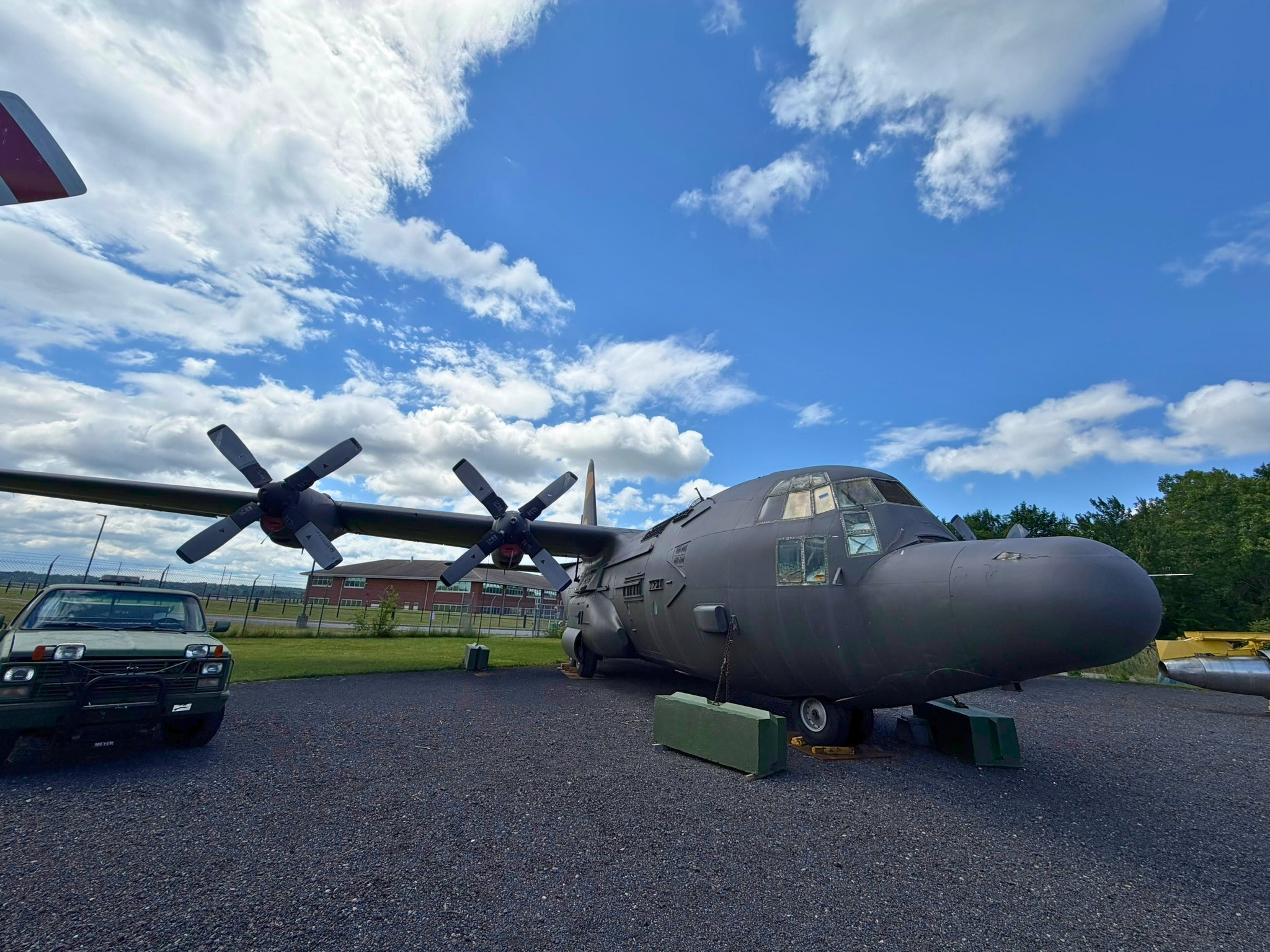
The Lockheed MC-130 is the basic designation for a family of special-mission aircraft operated by the United States Air Force Special Operations Command (AFSOC), a wing of the Air Education and Training Command, and an AFSOC-gained wing of the Air Force Reserve Command. Based on the Lockheed C-130 Hercules transport, the MC-130s' missions are the infiltration, exfiltration, and resupply of special operations forces, and the air refueling of (primarily) special operations helicopter and tilt-rotor aircraft.
The first of the variants, the MC-130E, was developed to support clandestine special operations missions during the Vietnam War. Eighteen were created by modifying C-130E transports, and four were lost through attrition[citation needed], but the remainder served more than four decades after their initial modification. An update, the MC-130H Combat Talon II, was developed in the 1980s from the C-130H and went into service in the 1990s. Four of the original 24 H-series aircraft have been lost in operations.
The Combat Shadows were built during the Vietnam War for search and rescue operations and repurposed in the 1980s as AFSOC air-refueling tankers; the last of the 24 retired in 2015.
The Combat Spear was developed in 2006 as an inexpensive version of the Combat Talon II but was reconfigured and designated the AC-130W Stinger II in 2012.
The MC-130J, which became operational in 2011, is the new-production variant that is replacing the other special operations MC-130s.[6] As of 2023, the Air Force has taken delivery of 57 MC-130J models.[7] The final MC-130J produced was delivered to USAF in January 2025.[8]


The Combat Talon was developed between December 1964 and January 1967 by Lockheed Air Services (LAS) at Ontario, California, as the result of a study by Big Safari, the USAF's program office that modifies and sustains special mission aircraft. Two highly classified testbed aircraft (originally serial no. 64-0506 and -0507, but with all numbers "sanitized" from the aircraft), were assigned to Project Thin Slice to develop a low-level clandestine penetration aircraft for Special Forces operations in Southeast Asia.[9] In 1964, Lockheed was ordered to adapt the C-130Es after six C-123B Providers modified for "unconventional warfare" under Project Duck Hook proved inadequate for the new MACV-SOG.[10] The modifications under Thin Slice and its August 1966 successor Heavy Chain were code-named Rivet Yard,[11] and the four C-130Es came to be known as "Yards".[12] Discreet modification tests were conducted by the 1198th Operational Evaluation and Training Squadron, out of Area II of Norton AFB at San Bernardino, California, 30 miles east of Ontario.[13][14]

As the Thin Slice aircraft were being developed, 14 C-130Es were purchased for SOG in 1965 for similar modification. The first aircraft were production C-130Es without specialized equipment that were produced at Lockheed's facility in Marietta, Georgia. Three production airplanes per month were given the Fulton STARS (then ARS) system.[10] While awaiting the ARS equipment, the C-130s were ferried to Greenville, Texas, for painting by Ling-Temco-Vought Electrosystems with a low-radar reflective paint that added 168 kg (370 lbs) to their weight. The velvet black-and-green scheme drew the nickname "Blackbirds".[15] As installation was completed, the Blackbirds were returned to Ontario for installation of the electronics package, code-named Rivet Clamp. The modified aircraft became known as "Clamps" (two of the original 14, 64–0564 and -0565, were diverted to Heavy Chain in August 1966).[10] The aircraft collectively were assigned the designation Combat Talon in 1967.[16]
The Fulton surface-to-air recovery system was used to extract personnel and materials via air. A large helium balloon raised a nylon lift line into the air, which was snagged by a large scissors-shaped yoke attached to the nose of the plane. The yoke snagged the line and released the balloon, yanking the attached cargo off the ground with a shock less than that of an opening parachute. A sky anchor secured the line and wires stretched from the nose to both leading wing tip edges, protecting the propellers from the line on missed snag attempts. Crew members hooked the snagged line as it trailed behind and attached it to the hydraulic winch, pulling the attached person or cargo into the plane through the rear cargo door.