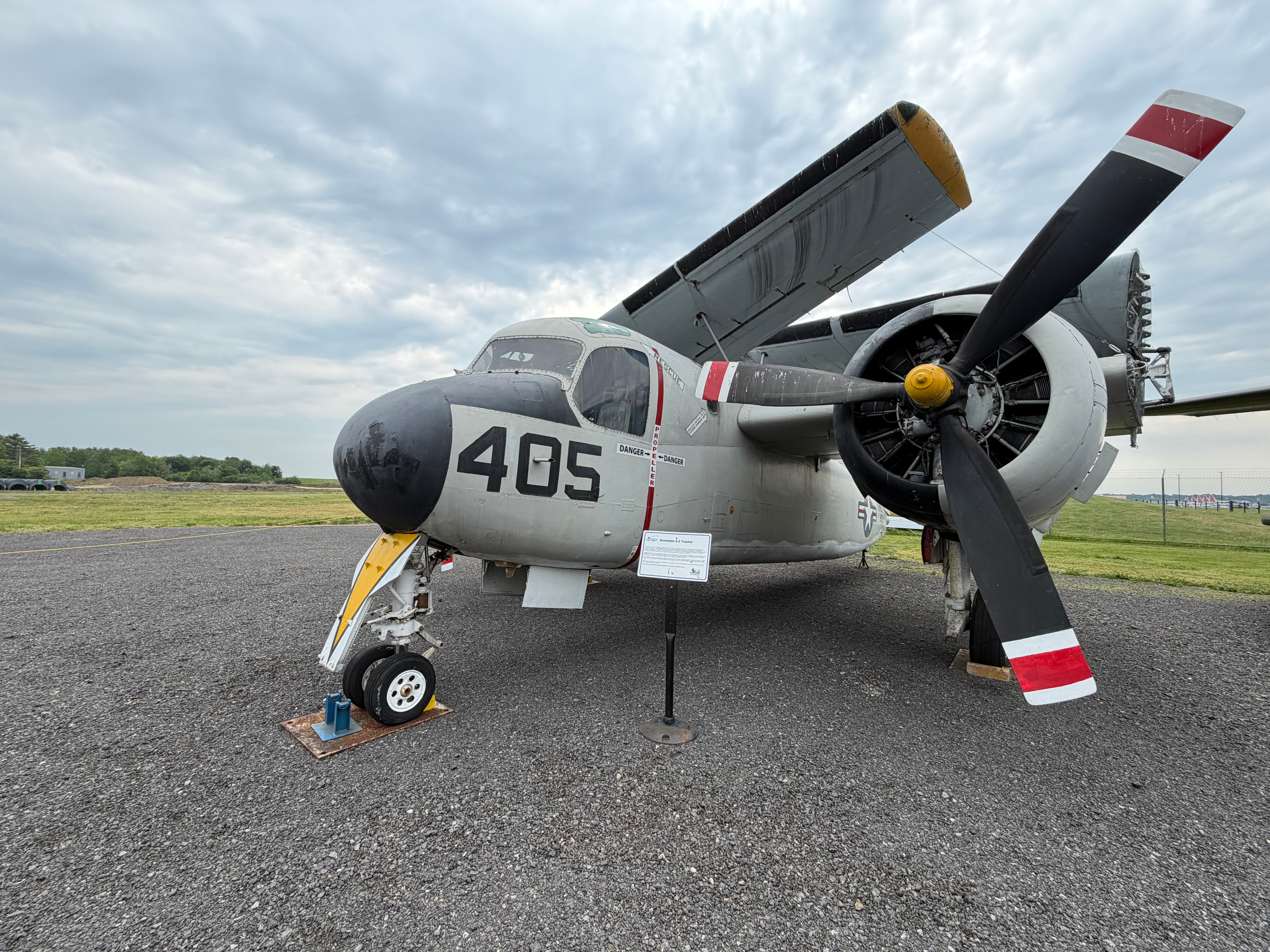
The Grumman S-2 Tracker was designed in the early 1950’s as the first purpose-built anti-submarine warfare aircraft capable of performing both the
detection and attack roles. Previously, planes such as the Grumman Guardian and Avenger had to operate in hunter-killer teams. Designed and manufactured by Grumman at its Long Island facilities, the Tracker first flew in 1952 and entered operational service with the U.S. Navy in 1954. The S-2 was an icon of the Cold War era and the bane of the Soviet submarines. Over 1,200 Trackers were manufactured, most used by the U.S. Navy aboard aircraft carriers, but several foreign countries also used the Tracker, including Canada, Australia, Japan, and Taiwan.
Originally designated the S-2F, and affectionately called the “STOOF” (S-Two-F), the Tracker utilized sonobuoys, a Magnetic Anomaly Detector boom, and a searchlight to detect enemy submarines; and torpedoes, rockets, and depth charges (including a nuclear armed version) to attack them. The S-2 had a maximum speed of 280 mph, was powered by two Wright R-1820 radial engines, and carried a crew of four.
The S-2 enjoyed a long career, and was eventually retired from the U.S. Navy in 1976, being replaced by the jet-powered Lockheed S-3 Viking. As of 2008, however, a number are still active with the State of California in the firefighting role, capable of carrying 800 gallons of water or other retardant for this mission.
ESAM’s Tracker was delivered to the U.S. Navy during 1955, and later converted to a trainer and designated TS-2. It was acquired from the USS Intrepid Sea, Air & Space Museum in New York City.
THIS AIRCRAFT IS ON LOAN FROM THE NATIONAL MUSEUM OF NAVAL AVIATION AT PENSACOLA, FLORIDA.