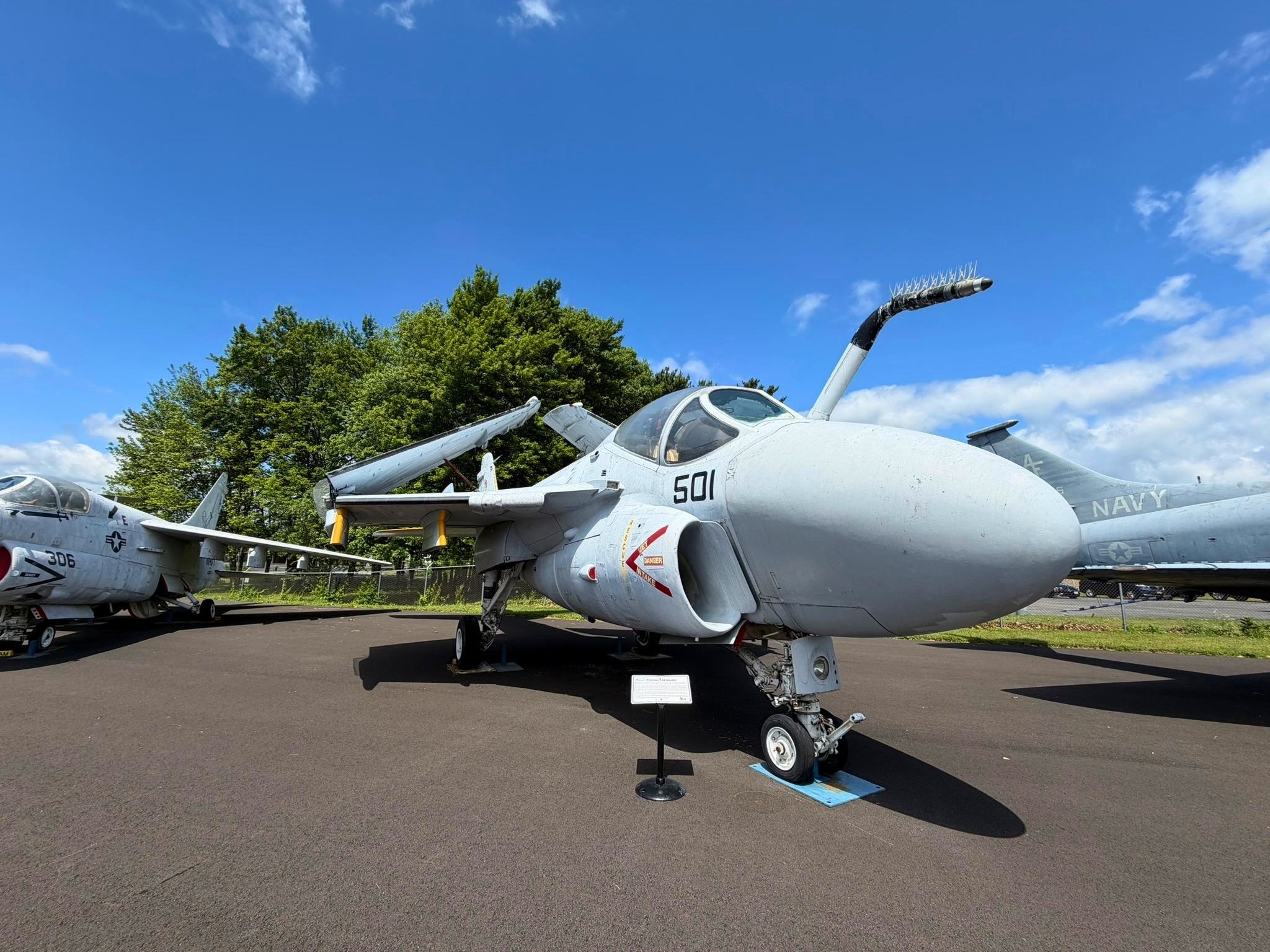
The A-6 was one of the U.S. Navy’s most combat-effective and longest serving aircraft. Developed during the late 1950’s as a replacement for the World War II-era A-1 Skyraider, the A-6 emerged as a twin-engine, two-seat, carrier-based attack bomber for the U.S. Navy and Marine Corps. The A-6 was special because of its unique ability to accurately deliver a heavy bomb load over long distances at night or in all-weather conditions. Manufactured in New York State by the Grumman “Iron Works” facilities on Long Island, nearly 700 were delivered to the Navy and Marine Corps, beginning in 1963.
Its distinctive large and bulbous nose housed an extensive suite of search and target tracking radar, radar altimeter, and inertial navigation equipment, all linked by an on-board computer which allowed the pilot and bombardier/navigator to accurately navigate and deliver a heavy bomb load at low level, at night or in foul weather. Together with an array of electronic jamming equipment, the A-6 was one of the most complex and expensive aircraft in service at that time. The first production version, the A-6A, was equipped with vacuum tube technology, which required enormous maintenance. In 1970, Grumman introduced the much-improved A-6E version, featuring solid-state digital electronics, which proved much more reliable and drastically reduced maintenance time. Derivatives of the A-6 include the EA-6B Prowler, a four-seat dedicated electronic warfare aircraft introduced into Navy service during 1971, and the KA-6D, a modified version used as an air refueling tanker.
The A-6 was quickly deployed for service in the Vietnam War, and saw extensive service during that conflict, frequently used to attack high-value targets at night, deep into North Vietnam. Until introduction of the U.S. Air Force’s F-111 in 1968, the A-6 was the only strike aircraft in the world with all-weather capabilities. The Intruder also saw extensive service during the 1991 Gulf War.
The design of the A-6 features a rugged landing gear, able to withstand the stressful catapult launches and arrested landings typical of carrier operations, and its overall design is optimized for low level operations. Powered by two Pratt & Whitney J52 turbojets, the A-6 had a maximum speed of 650 mph and could carry up to 15,000 lbs of ordinance on five pylons under the wings and fuselage. On a typical strike mission, the A-6 would be equipped with one or two external fuel tanks and a bomb load of 6,000 - 12,000 lbs. Over time, the A-6 was modified to carry virtually every type of air-to-ground ordinance in use by the Navy. The A-6 was eventually retired from service in 1997, having been replaced by the F/A-18 Hornet.
ESAM’s A-6 was built in 1967, modified to the A-6E standard, and enjoyed a long career with the U.S. Navy until its retirement in 1992. It participated in the Vietnam War, and over the years was deployed on the carriers USS America, Nimitz, Saratoga, and Forrestal. Its markings reflect its service with Attack Squadron 176 onboard the USS Forrestal.
THIS AIRCRAFT IS ON LOAN FROM THE NATIONAL MUSEUM OF NAVAL AVIATION AT PENSACOLA, FLORIDA.