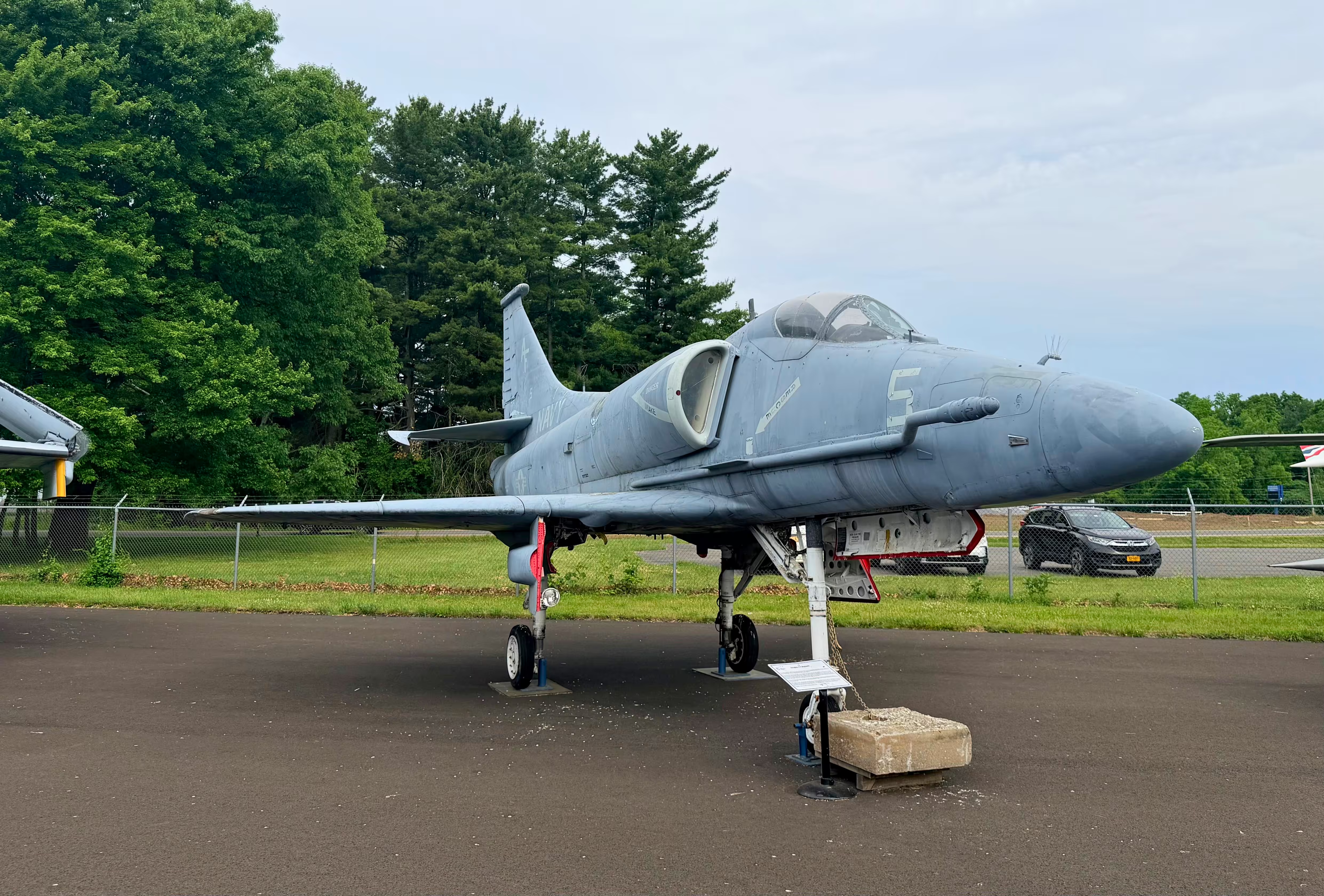
The A-4 was the brainchild of Douglas’ Ed Heinemann, one of the United States’ most famous and successful aircraft designers. The A-4, or “Scooter,” is unique for its compact size - it more resembles a fighter than a bomber. In this regard, no attack plane probably ever packed so much punch in so small a package. With its robust construction, its ability to absorb battle damage was legendary.
The A-4 entered operational service during 1956, and when production finally ended in 1979, nearly 3,000 examples in 17 different versions had been delivered to U.S. Navy, Marine Corps, and various foreign countries. At the height of its deployment during the Vietnam War, aircraft carrier air wings typically included two 12-plane attack squadrons of A-4s. During that conflict, the A-4 flew more attack missions than any other Navy aircraft. The A-4 did have some limitations, such as a relatively short range and lacked all-weather capabilities. Although the U.S. Navy began replacing the Skyhawk in front line squadrons around 1970 with the newer A-7 Corsair, which offered better range, more sophisticated avionics, and a heavier bomb load, the Marine Corps never gave up the “Scooter”. The last A-4s were eventually retired from U.S. reserve units during 2003.
The A-4 was sub-sonic and could achieve a top speed of 670 mph, however, when laden with bombs and flying at low altitude in dense air, this was somewhat of a brochure figure. Typical ordinance load for the Skyhawk was 5,000 lbs of bombs, with two internally-mounted 20mm cannon, as well as one or two external fuel tanks.
ESAM’s Skyhawk is an A-4F, which previously served with the U.S. Navy aboard the carrier USS Hancock from 1968-72 and participated in the Vietnam War. Its last posting was with Composite Squadron 12 at Naval Air Station Oceana, Virginia where it served in the “aggressor” role. The A-4 was extremely maneuverable and also was famous as the mount of the Navy’s Blue Angels demonstration team. Since the A-4 was so maneuverable, it served in the aggressor role, where pilots flying the much larger F-4 and F-14 fighters would practice the art of dog fighting against the nimble Skyhawk.
THIS AIRCRAFT IS ON LOAN FROM THE NATIONAL MUSEUM OF NAVAL AVIATION AT PENSACOLA, FLORIDA